Friday, June 2, 2017

What is the "right" amount of inventory information to collect?

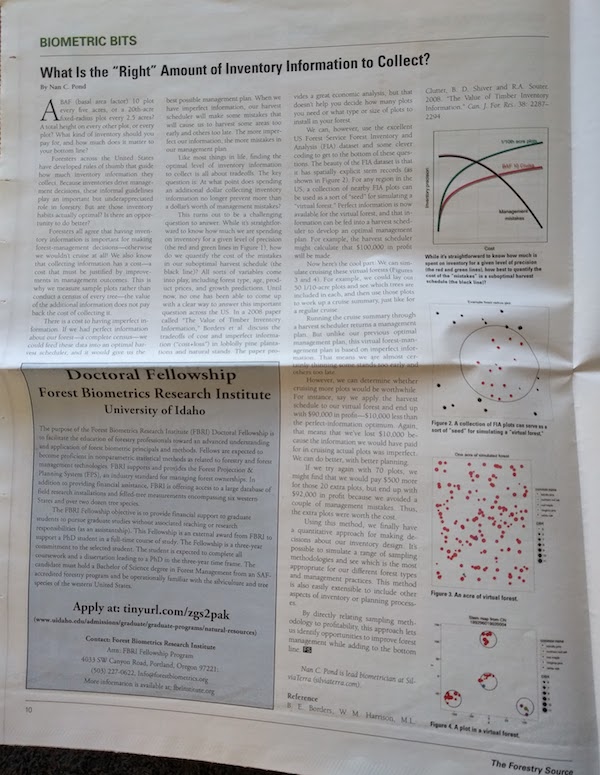
The following post originally appeared in the Forestry Source.  It was written by SilviaTerra's lead biometrician, Dr. Nan Pond.


A BAF 10 plot every 5 acres, or a 20th acre fixed radius plot every 2.5?  A total height on every other plot, or every plot? What kind of inventory should you pay for, and how much does it matter to your bottom line?
Foresters across America have developed rules of thumb that guide how much inventory information they collect.  Because inventories drive management decisions, these informal guidelines play an important but underappreciated role in forestry.  But are those inventory habits actually optimal?  Is there an opportunity to do better?

We all agree that having inventory information is important for making forest management decisions.  Otherwise we wouldn't cruise at all!  But we also know that collecting information has a cost - a cost that must be justified by improvements in management outcomes.  This is why we measure sample plots rather than conducting a census of every tree - the value of the additional information does not pay back the cost of collecting it.
 Max_figure.png

But there is a cost to having imperfect information.  If we had a perfect information - a complete census - about our forest, we could feed that data to an optimal harvest scheduler and it would give us the best possible management plan.  When we have imperfect information, our harvest scheduler will make some "mistakes" that cause us to harvest some areas too early and others too late.  The more imperfect our information, the more mistakes we'll have in our management plan.

Like most things in life, finding the optimal level of inventory information to collect is all about tradeoffs.  The key question is: "at what point does spending an additional dollar collecting inventory information no longer prevent more than a dollar of management mistakes?"

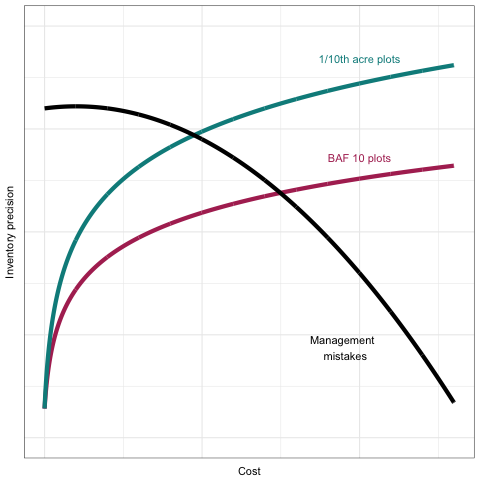
This turns out to be a challenging question to answer.  While it's
straightforward to know how much we are spending on inventory for a given level of precision (the red and green lines), how do we quantify the cost of the "mistakes" in our suboptimal harvest schedule (the black line)?  There are all sorts of variables that come into play, including forest type, age, product prices, growth predictions, etc.  Until now, no one has been able to come up with a clear way to answer this important question across the US.  In a 2008 paper called "The Value of Timber Inventory Information", Borders et al. discuss the tradeoffs of cost and imperfect information (“cost+loss”) in loblolly pine plantations and natural stands. This paper gives a great economic analysis, but that doesn’t help you decide how many plots, and what type or size of plots to install in your forest!
 stemMap.png
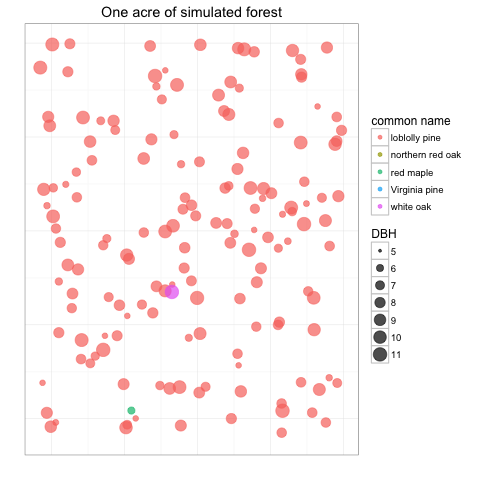
However, it turns out that we can use the excellent USFS FIA dataset and some clever coding to get to the bottom of this.  The beauty of the FIA dataset is that it has spatially-explicit stem records (as shown in the diagram on the left).  For any region in the US, we can use a collection of nearby FIA plots as a sort of "seed" for simulating a "virtual forest"

We now have perfect information for our virtual forest and can feed that information to a harvest scheduler to develop the optimal management plan.   In this example, the harvest scheduler tells us we'll make $100K in profit.
forestMap.png

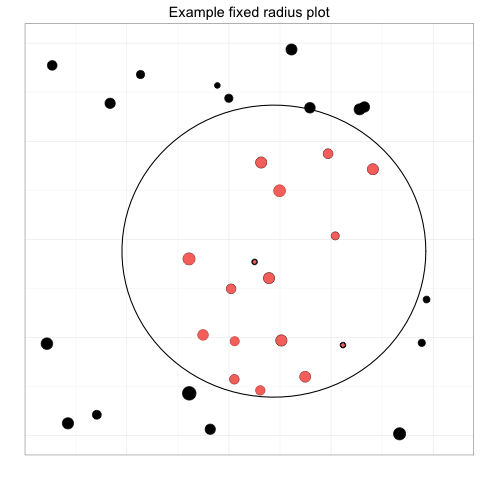
Now here's the cool part - we can simulate cruising our virtual forest.  For example, we could lay out 50 1/10 acre plots and see which trees are included in each.  Then we use those plots to work up a cruise summary just like for a regular cruise.

We run the cruise summary through a harvest scheduler and it returns a management plan.  But unlike our optimal management plan from before, this management plan is based off of imperfect information.  That means we are almost certainly thinning some stands too early and others too late.

And we can find out!  We apply the harvest schedule to our virtual forest and in this example, we end up with $90K in profit - $10K less than the perfect information optimum. Again, that means that we lost $10K because the information we bought was imperfect. We can do better, with better planning.
fixedRadPlot.png

If we try again with 70 plots, we might find that we pay $500 more for those 20 extra plots, but end up with $92K in profit because we avoided a couple of management mistakes.  The extra plots were worth it.

Using this method, we finally have a quantitative approach for making decisions about our inventory design.  It's possible to simulate a range of sampling methodologies and see which is the most appropriate for our different forest types and management practices.  This method is also easily extensible to include other aspects of our inventory or planning processes.

By directly relating our sampling methodology to our profitability, this approach lets us identify opportunities to improve our forest management while adding to the bottom line.  There's much more to say about the results of this approach in different forest types - and recommendations we’ll make - stay tuned for more biometrics analysis in next month's issue!


Works Cited
B. E. Borders, W. M. Harrison, M.L. Clutter, B. D. Shiver and R.A. Souter. 2008. The Value of Timber Inventory Information. Can. J. For. Res. 38: 2287-2294.

Monday, May 22, 2017

Presenting at ACF 2017 in Tahoe

Greetings from the beautiful shores of Lake Tahoe!  We're exhibiting at the Association of Consulting Foresters meeting in Incline Village, Nevada.  We're giving lots of demos of the new Plot Hound customization features and our new and powerful (and free!) plot layout tool in Canopy.  We're also excited to be bringing the power of remote-sensing to all consulting foresters with our CruiseBoost service.  We've spent the last year automating much of our satellite image analysis so that foresters working on properties as small as 40 acres can still take advantage of the power of remote sensing.

It's always great to meet consulting foresters using Plot Hound and CruiseBoost to make their inventory work easier - swing by the booth if you're in town!

SilviaTerra founders Max and Zack
trying to figure out what to do with their hands

Thursday, May 18, 2017

Plot Hound is turning 6, and we're celebrating with a brand new version!


Screen Shot 2017-04-28 at 6.18.54 PM.png


For the last six years, SilviaTerra has been striving to build the best possible mobile cruising experience. Our 100% free Plot Hound application has been put to use in plots across the country (and the world!), with continuous improvement that has only been possible thanks to the feedback and suggestions from the thousands of cruisers who have used Plot Hound.

That’s why we’re excited to announce that we’ll soon be making Plot Hound ever better with a major new release. Version 6.0 will be out this summer, and it’s packed with new features. The biggest change is custom data types and validation. This means you’ll have the ability to go beyond a few generic data entry fields, increasing flexibility and reliability of your data. We know every cruise is different, and now that Plot Hound is being used all over the world it’s more important than ever that we can tailor the cruising experience to you.


Want to use the new Plot Hound on an upcoming cruise? Feel free to reach out to us at support@silviaterra.com. We’re now officially opening the version 6 beta signup - for both Android and iPhone.

New to Plot Hound? Find out more at https://silviaterra.com/bark/plothound.html

Monday, May 15, 2017

Launching the "Biometrics Bits" column in the Forestry Source

forestry-source.jpgWe're excited to announce that the SilviaTerra biometrics team just published its first "Biometrics Bits" column in the Forestry Source - the Society of American Foresters newspaper. Our first article explored the question - "What is the 'Right' Amount of Inventory Information to Collect?"

Using the fantastic FIA dataset, SilviaTerra's Lead Biometrician Dr. Nan Pond simulated many different cruising methods and intensities. Using this approach, we arrived at a rigorous and quantitative answer to the question "when does spending an additional dollar on inventory result in less than a dollar's worth of better management decisions?" in a variety of forest types in the US.

We're excited to share our thoughts on biometrics with the wider forestry community - stay tuned for plenty more articles!

Monday, May 8, 2017

Brian Clough joins SilviaTerra


The SilviaTerra team is thrilled to announce our newest member, Dr. Brian Clough.  Brian comes to us after completing several years of postdoctoral research at the University of Minnesota.  He brings a great set of skills to complement our current biometrics team, including experience with biomass and carbon modelling, and a solid background in Bayesian modelling techniques.  


Brian is originally from the northeastern US, where he earned his PhD in Ecology and Evolution at Rutgers University.  SilviaTerra’s remote work system will allow him to continue to call Minnesota home for the time being. He’s already hard at work improving our automated height modelling systems, along with learning about the rest of our systems.  Welcome, Brian!

Some of the SilviaTerra team, together for a recent development week
(L:R Nan Pond, Mike Holkesvik, Brian Clough, Henry Rodman)


Thursday, March 23, 2017

SilviaTerra founder speaks at Center for Business and the Environment at Yale 10 year anniversary @ Google SF


SilviaTerra founder Zack Parisa spoke yesterday at the Center for the Business and the Environment at Yale 10 year anniversary event hosted at the Google San Francisco office.  Other speakers included Dr. Indy Burke, the Dean of the Yale School of Forestry & Environmental Studies and Stuart DeCew, the Director of CBEY.

Zack spoke about how SilviaTerra originated from his Yale M.F.S. thesis work on helping rural Armenian villages manage their forests better.  Without accurate and recent forest inventory information, any management planning was useless.  In response, Zack developed what became the core SilviaTerra satellite imagery analysis technology so that he and his small team of local foresters could develop a forest inventory data layer across much of the country.

The focus on enabling better management decisions has been at the heart of SilviaTerra since the very beginning.  From our original work enabling villagers in Armenia to manage their firewood supply to helping many of the largest American environmental and industrial landowners achieve their conservation and production goals, SilviaTerra has always been driven by the idea that better data can enable better decisions.  Zack described how richer information about our forests is enabling the valuation and management of new, non-fiber ecosystem services and the role that information-providers like SilviaTerra play in building a future where our forests are managed efficiently, accurately, and equitably.

If that sounds like a future you'd like to help build - we're hiring!

Thursday, March 9, 2017

SilviaTerra Spring Conference Schedule


Great meeting lots of current and future 
Plot Hound users at NESAF 2017

Greetings from the New England Society of American Foresters meeting in Bangor, Maine!  SilviaTerra is on the conference circuit this month - come swing by the booth and say hi:

  • New England SAF - March 8-10
  • Inland Empire SAF - March 27-28
  • Washington SAF - March 29-30
  • Timber Measurements Society (Portland) - April 12-14
  • Oregon SAF - April 26-27
  • Virginia ACF - May 3